


Skip to content
UNSO · 2025

08th Uganda National Science Olympiad

Back to programme
UNSO 2025 · Complete archive

The Hekima Edition
Knowledge was only the beginning.

The 2025 Olympiad asked students to move beyond knowing science - to weigh evidence, question assumptions and decide what conclusions their investigations could truly support.

01 / REGIONAL QUALIFIERS

Regional Round
Research gathers knowledge.

Through months of Regional Qualifier work, teams had to decide what to measure, what to trust, what to question and how far their evidence could carry them.

UNSO 2025 Regional Qualifiers
RESEARCH CYCLE2025
2468teams enteredRegional Qualifiers participation
14808studentsYoung scientists taking part
94schoolsInstitutions represented
48teams advancedOfficial National Round qualifiers
Research Problems

The questions that shaped the qualifier.

Each problem becomes both a research assignment and, after assessment, a record of the team whose work stood out most strongly.

01
Research Problem

The Art of Circuit Design: Creating Functional Circuits with Components

Explore the principles of circuit design by creating a functioning circuit using common electronic components (resistors, capacitors, LEDs, and transistors). Challenge participants to design a specific function, such as a simple alarm system or a light dimmer.  How do different configurations of components (series vs. parallel) affect the overall performance of the circuit?  Can you analyze the energy efficiency of the circuit and propose improvements to minimize power consumption?

BEST RESEARCH
VabasHorizon International School
02
Research Problem

The Lifecycle of Stars: Investigating Stellar Evolution

Stars undergo various stages throughout their lifecycle, from formation to their end as white dwarfs, neutron stars, or black holes. Investigate the factors influencing stellar evolution, such as mass, temperature, and chemical composition.  How do different initial masses affect the lifecycle of a star, and what observational methods can be used to identify stars at different stages?  Can you create a model or simulation that illustrates the lifecycle of a star and predicts the characteristics of a star based on its mass and composition?

BEST RESEARCH
Virgin VirginsNamilyango College
03
Research Problem

Powering the Future: Investigating Energy Sources for Satellites

Satellites rely on energy sources to maintain communication and perform their functions in space. Investigate the effectiveness of different energy sources, such as solar panels or batteries, in powering satellites. Explore how solar radiation, temperature fluctuations, and distance from the Sun impact energy efficiency.  How do the energy demands of different satellite functions (e.g., transmitting data, stabilizing orbit) affect the choice of energy sources? a. Can you design an experiment to simulate the efficiency of solar cells under different conditions, such as varying light intensity or temperature, and suggest improvements for energy sustainability in space?

BEST RESEARCH
Team AlphaBudo Secondary School
04
Research Problem

The Chemistry of Clean: Investigating the Effectiveness of Household Cleaning Agents

Cleaning products are designed to remove dirt, stains, and bacteria, but how effective are they under different conditions? Investigate the chemical mechanisms behind common cleaning agents (e.g., soaps, detergents, or disinfectants) and analyze their effectiveness on different surfaces or stains. Study how factors like pH, temperature, and concentration affect cleaning power.  How do chemical additives, such as surfactants or enzymes, enhance the cleaning process?  Can you develop an environmentally friendly cleaner that maintains or improves upon the efficiency of traditional chemicals?

BEST RESEARCH
The SagesMaryhill High School
05
Research Problem

The Power of the Atom: Investigating Nuclear Fission and Energy Production

Nuclear fission is a powerful process used in nuclear reactors to generate energy. Investigate the principles of nuclear fission, focusing on the conditions required for the reaction and its energy output. Conduct experiments using safe materials to simulate fission reactions, exploring factors such as neutron absorption and the impact of different isotopes on the fission process.  How does the configuration of fissionable materials affect the efficiency of energy production?  Can you model a simple system to demonstrate the chain reaction process and analyze how control mechanisms are implemented in real reactors?

BEST RESEARCH
BrainiacsMengo Senior School
06
Research Problem

The Strength of Bonds: Investigating the Factors Influencing Bond Strength

Chemical bonds vary in strength and stability, influenced by factors like bond type (ionic, covalent, or metallic) and molecular geometry. Investigate how different factors—such as electronegativity, atomic size, and molecular shape—affect the strength of bonds in various compounds. Conduct experiments comparing the melting or boiling points of substances with different types of bonds.  How do the types of bonds present in a compound affect its physical properties, such as solubility or conductivity?  Can you create a model to predict bond strength based on molecular structure and explain discrepancies observed in real compounds?

BEST RESEARCH
VabasHorizon International School

07
Research Problem

The Secret Language of Plants: Communication through Chemical Signals

Plants are not silent observers in nature; they communicate using chemicals. Investigate how plants use chemical signals to interact with each other and their environment. Explore how certain plants release chemicals to warn neighboring plants of pests or trigger defense mechanisms. Analyze the influence of these signals on plant growth, behavior, and survival.  Can plants "sense" when their neighbors are under attack, and how does this affect their own growth or defense strategies?  Investigate the phenomenon of "allelopathy"—how one plant inhibits the growth of another through chemical release.

BEST RESEARCH
VulturesLubiri Secondary School
08
Research Problem

The Battle of the Sexes: Investigating Plant Reproductive Strategies in Changing Environments

Some plants can switch between self-pollination and cross-pollination based on environmental conditions to ensure reproductive success. Investigate how environmental stressors, such as nutrient deficiency, drought, or crowding, influence a plant’s choice of reproductive strategy.  How does the balance between self-pollination and cross-pollination affect the genetic diversity of offspring?  Can plants "sense" when cross-pollination is no longer viable and shift toward self pollination as a survival mechanism?

BEST RESEARCH
Formula FrontiersKira College Butiki
09
Research Problem

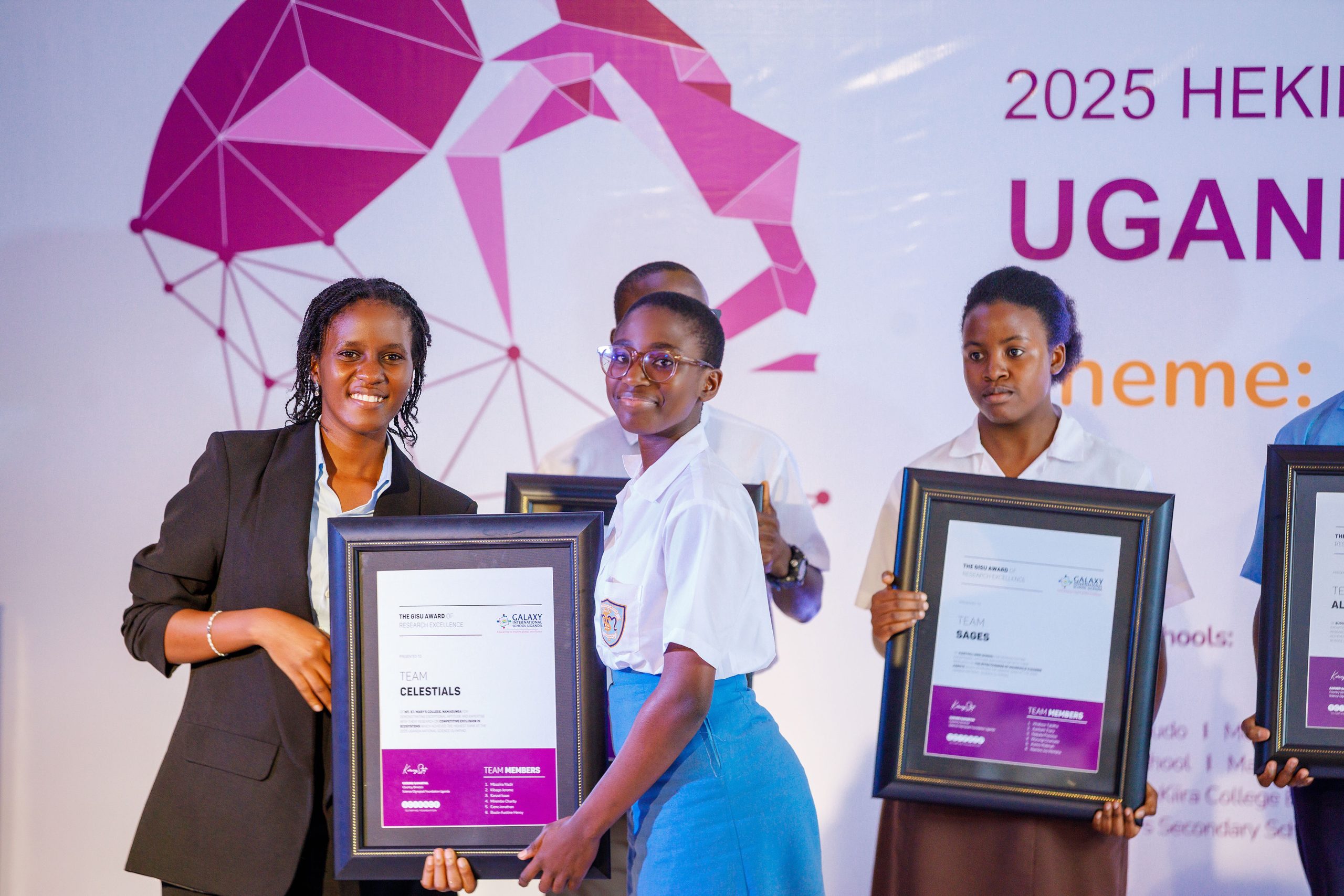
The Struggle for Space: Investigating Competitive Exclusion in Ecosystems

In ecosystems, different species compete for limited resources like space, nutrients, and sunlight. Explore the phenomenon of competitive exclusion, where one species outcompetes another for a particular resource, often leading to local extinction. Study the dynamics of species competition in a controlled environment, such as aquatic plants competing for light or animals competing for nesting sites.  How do environmental stressors (e.g., limited resources, pollution, or climate change) influence the outcome of competitive interactions?  Can species coexist by partitioning resources, and if so, how does this affect the biodiversity and stability of the community?

BEST RESEARCH
CelestialsMt. St. Mary's College, Namagunga
National qualifiers

48 teams advanced.

Top 48 Teams nationally proceeded to the National Round

Open official results ↗
UNSO 2025 National Tournament
NATIONAL TOURNAMENT2025
02 / NATIONAL TOURNAMENT

National Round
Every claim was tested!

At Nationals, scientific judgement became public. Teams defended their own reasoning, interrogated the work of others and were tested on how well they could think under scrutiny.

Date21 Jun 2025
Championship podium

Three teams. One national finish.

The podium is told through the actual award moments wherever photographs have been uploaded.

Team Sci-Giants - Bweranyangi Girls Secondary School
01Champion

Team Sci-Giants - Bweranyangi Girls Secondary School

Team Eureka Effect - Gayaza High School
021st Runner-up

Team Eureka Effect - Gayaza High School

Team Venosus - Lubugumu Jamia High School
032nd Runner-up

Team Venosus - Lubugumu Jamia High School

Top Performing Schools

School-wide excellence.

Separate from the championship podium, these schools are recognised for overall tournament performance.

01Overall school performance
Bweranyangi Girls Secondary School
02Overall school performance
Lubugumu Jamia High School
03Overall school performance
Greenhill Academy
National Round problems

The problems debated in the Science Fights.

01Sorghum Porridge ViscositySorghum porridge (“bushera”) thickens upon cooling. Investigate the rheological properties of sorghum-based porridge as it cools.
02Drumming DustWhen you beat a traditional drum that's been unused for a while, you might see a puff of dust rise from the surface. Investigate the generation and dispersion of this dust cloud. What factors influence the pattern and spread of the dust?
03Charcoal Stove MysteriesCharcoal stoves ("sigiri") are widely used across Uganda. Users often observe that the stove behaves differently depending on the arrangement of the charcoal and the airflow. Investigate how different arrangements and levels of ventilation affect the efficiency, temperature, and smoke production of a sigiri.
04Mirror MysteriesWhen you look into a mirror, your left and right seem to be flipped, but your up and down aren't. Why does this happen? Investigate the perception of mirrored images and the physics behind how mirrors work. Do mirrors truly flip left and right, or is this just an illusion? Consider how the symmetry of reflection affects our perception of orientation.
05The Water Memory PuzzleSome theories in alternative medicine claim that water retains a "memory" of substances once dissolved in it, even after dilution beyond measurable levels (as in homeopathy). Investigate whether water can retain any measurable physical or chemical trace after repeated serial dilutions & whether this affects its behavior in any way.
06The Life of Ice CubesWhy do ice cubes in some countries or cities freeze clearer and melt slower than in others? Explore the science behind crystal-clear ice and its rate of melting.
07The Phantom Phone VibrationHave you ever felt your phone vibrate - only to check and find nothing? Many people experience “phantom phone vibrations.” Investigate this phenomenon.
08The Boiling Milk PhenomenonMilk tends to boil over quickly and messily, while water doesn’t. Investigate the physical and chemical reasons behind milk’s explosive boil-over. Can you model or prevent it effectively?
09Why Do Some Sounds Feel Pleasant - and Others Painful?Some sounds (like running water) calm us, while others (like nails on a chalkboard) cause discomfort. Investigate the science of sound perception. What determines the emotional response to a sound?